The front door can have a camera. The living room cannot – and that rule is not up for negotiation
By David Myers, Broker Associate · MyOrlandoVacationHome.com · Last updated November 2026
Airbnb and Vrbo both ban security cameras and audio recorders inside a short-term rental (STR), even when they are disclosed or switched off. Exterior cameras are allowed when they are disclosed in the listing and stay away from places like an enclosed outdoor shower or sauna, and Vrbo adds a disclosure at the property when a camera can see the pool or hot tub. Noise monitors that measure decibels without recording audio are allowed with disclosure, but not in bedrooms, bathrooms or sleeping areas on Airbnb. Florida law adds its own limits on recording people where they expect privacy and on recording conversations. Buyers of a home that is already renting should check every device before the first booking.
An Orlando vacation home sits empty for weeks at a time, then fills with a group of twelve the owner has never met. Wanting to keep an eye on it is reasonable. The platforms and Florida law decide exactly how far that eye can reach.
Here is what is allowed, what is not and what to check when you buy a home that came with a few gadgets already on the walls.
Can You Put Security Cameras Inside a Vacation Rental?
No – Airbnb and Vrbo both ban cameras inside the home, whether or not they are disclosed.
Airbnb announced a global ban on indoor security cameras in March 2024, and it took effect on April 30, 2024. Its help center says hosts may not have devices that monitor any part of a home's interior, "such as the hallway, bedroom, bathroom, living room, or guest house, even if they're turned off or disconnected." Hidden cameras are strictly prohibited.
Vrbo's surveillance policy, published by its parent company Expedia Group, says cameras and audio recorders "are not allowed inside of a vacation rental." It also bans a camera outside the home that points in, such as one aimed through a window.
Most Orlando vacation homes are listed on both platforms, so the practical rule is simple: nothing inside the house that records or transmits video, images or audio. Airbnb's definition includes baby monitors.
Which Outdoor Cameras Are Allowed?
Exterior cameras that are disclosed in the listing and stay out of private spaces.
Both platforms allow outdoor security cameras with conditions. Airbnb requires hosts to disclose them in the listing description and does not allow them over areas with a greater expectation of privacy, "such as the inside of an enclosed outdoor shower or in a sauna."
Vrbo is stricter in a few ways that matter for a pool home:
- Cameras must monitor the access points of the property.
- Their location and coverage must be clearly disclosed in the listing, and showing the camera in a listing photo is not enough.
- If a camera can see the pool or hot tub, the disclosure must appear in the listing and at the property, and it must say the pool or hot tub is visible to the camera.
- Recordings should be kept only as long as needed, then deleted.
Many Orlando pool homes have a screened lanai off the back of the house, so a camera on the rear corner can easily take in the whole pool deck. If the goal is watching the driveway and the front door, point it at the driveway and the front door.
Are Doorbell Cameras and Smart Locks Allowed?
Yes – an exterior doorbell camera is allowed with disclosure, and smart locks are standard equipment.
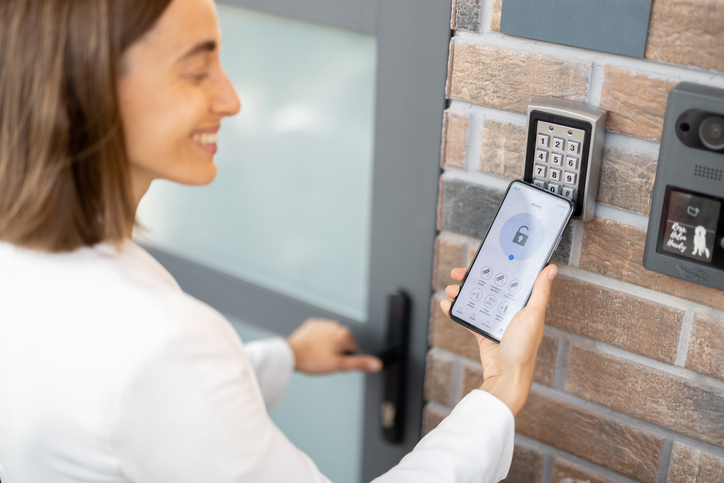
Airbnb counts a doorbell camera as a security camera, so it follows the exterior camera rules: allowed outside, disclosed in the listing. A keypad or app-controlled smart lock is not a recording device. It lets a manager set a new code for each stay, and that removes the lost-key problem for guests who arrive late after a flight into Orlando.
Airbnb lets hosts have other smart home devices, such as smart TVs and voice assistants, and encourages, but does not require, disclosure and an option for guests to unplug them. Vrbo allows smart devices only if they are disclosed before booking and guests can turn them off. Listing on both platforms means following the stricter Vrbo version.
Can You Use a Noise Monitor?
Yes, if it measures sound levels without recording audio, and you disclose it.
A decibel monitor tracks how loud a room is and for how long. It does not capture what anyone says. Airbnb allows these devices inside the home "as long as the host discloses their presence and they are not located in bedrooms, bathrooms, or sleeping areas." You do not have to disclose where in the home the monitor is. Vrbo allows noise monitors if they are disclosed before booking and do not record or transmit audio.
A monitor in the living area or game room gives a manager an early alert before a neighbor calls the HOA. Our guide to noise rules for Orlando vacation rentals covers the county ordinances and how managers handle complaints. A camera that happens to have a microphone is not a noise monitor, and the platforms treat it as a recording device.
What Does Florida Law Say About Recording Guests?
Two state laws reach a vacation rental: one on recording people where they expect privacy, one on recording conversations.
Florida's digital voyeurism statute, section 810.145, makes it a crime to secretly view, record or broadcast someone dressing, undressing or exposing the body in a place where they expect privacy without their consent. The statute names "the interior of a residential dwelling" and bathrooms among those places. For an offender 19 or older it is a third-degree felony.
Florida's interception law, section 934.03, makes it a third-degree felony to intentionally intercept an oral communication. Recording is lawful when all parties have given prior consent. Many outdoor cameras and doorbell cameras record sound by default, so the safest setup on a rental home is to turn audio recording off. Whether a given recording breaks the statute is a question for a Florida attorney, not your manager.
What Should You Check When Buying a Home That Is Already Renting?
Every device in and around the house, and every listing that describes them.
Homes that have rented for years sometimes carry equipment installed before the 2024 rules, or added by a previous manager. When you buy a home that's already renting, walk it with your inspector or manager and list each device. Our guide to buying a vacation rental that's already renting covers the rest of the handover.
- Remove or disconnect any camera, baby monitor or audio recorder inside the home.
- Find out who controls each exterior camera's app and recordings, and move the account to you or your manager.
- Check where each exterior camera points, and whether it can see the pool, an outdoor shower or into a window.
- Turn off audio on exterior cameras and doorbells.
- Read the camera and device disclosure on every platform listing and update it to match.
- Reset smart lock codes and remove the seller's and old manager's access.
- Ask the HOA whether it restricts cameras or exterior equipment on the house.
Pros, Cons and Our Take
Pros
- Disclosed exterior cameras and doorbells show arrivals, departures and the number of cars.
- Noise monitors give an early warning without recording what anyone says.
- Smart locks remove key handoffs and let managers change codes for every stay.
Cons
- No indoor cameras, so damage inside is documented by the cleaners and inspection photos, not video.
- Disclosure rules differ between Airbnb and Vrbo, and a missing disclosure can cost you the listing.
- Audio recording and badly aimed cameras carry real legal risk under Florida law.
Our Take
Put cameras on the driveway and the front door, a decibel monitor in the main living area and a smart lock on the entry, and disclose all of it on every platform. Then let the turnover team be your eyes inside – see our guide to turnovers and cleaning – and back it up with a damage plan from our guide to security deposits and damage protection.
What Owners Should Know
- Read each platform's device policy once a year; Airbnb's changed in 2024.
- Keep a written list of every device, where it is and who has access to it.
- Ask any manager you interview how they handle cameras, noise alerts and lock codes.
- Talk with your insurance agent about what records help with a claim – see our guide to vacation rental insurance.
See our guides to self-managing an Orlando vacation rental, Airbnb vs Vrbo and our buyer's guide.
Official Sources
- Airbnb: restrictions on security cameras and other devices in homes
- Airbnb Newsroom: an update on our policy on security cameras
- Expedia Group (Vrbo): surveillance devices policy
- Florida Statute 810.145 (digital voyeurism)
- Florida Statute 934.03 (interception of communications)
Buying or selling an Orlando vacation home? Call/Text David Myers at 407.801.3286 or send us a message.
Frequently Asked Questions
Can I have security cameras inside my Airbnb?
No. Since April 30, 2024, Airbnb does not allow devices that monitor any part of a home's interior, even if they are turned off or disclosed. Vrbo also bans cameras and audio recorders inside a vacation rental.
Are outdoor cameras allowed at a vacation rental?
Yes, if they are disclosed in the listing and do not cover areas with a greater expectation of privacy, such as an enclosed outdoor shower or sauna. Vrbo also requires a disclosure at the property when a camera can see the pool or hot tub.
Can I use a noise monitor in my vacation rental?
Yes, if it measures sound levels without recording audio and you disclose it. Airbnb does not allow noise monitors in bedrooms, bathrooms or sleeping areas.
Does a doorbell camera count as a security camera on Airbnb?
Yes. Airbnb treats a doorbell camera as a security camera. An exterior doorbell camera is allowed but must be disclosed in the listing.
Should I remove cameras when I buy a vacation home?
Remove or disable any camera inside the home before the first booking, and confirm every exterior camera is disclosed on each platform where the home is listed.
David Myers is a licensed Florida real estate broker, working as a broker associate with Ziro Realty, and is not an attorney. This article is general information, not legal advice. Platform policies and laws change; confirm current rules with Airbnb, Vrbo and a Florida attorney.